Building Safe, Secure Intentional Communities: A Global How-To Guide for Women
Edition 1, November 2026 · 58-page fillable PDF with bonus budget spreadsheet built in · Instant download
$25· Includes the 57-page fillable PDF guide and a bonus budget spreadsheet
The spreadsheet is attached inside the PDF. Open it with the free Adobe Acrobat Reader to save it.
So many women say “I’m in!” to living in community. Then they get stuck on the same things: money, land, zoning, the law, and trust. This guide turns that wish into a plan you can actually follow, whether you’re starting with a shared rental or ten acres.
Built from years of real experience. This guide has been in the making since 2018, when I bought my land on the Oregon coast with the dream of shared, affordable, caring community. Years of trial and error followed: plans written and rewritten, people gathered and lost, and hard lessons about what happens when money and agreements are left unspoken. Every checklist here exists because I needed it. The guide also draws on a lifelong interest in cooperative living and in matrilineal and matriarchal societies around the world, and on more than 19 years of professional work managing money, property and care for others.
It’s written for women everywhere. It doesn’t pretend one country’s rules fit everyone. Instead it teaches you the right questions to ask where you live, then gives you the structures, real examples, budgets and documents to act on the answers.
Made to use, not just read. The worksheets, checklists, MOU and templates are fillable. Type right into the PDF and save it, or print the pages and fill them in by hand. A clickable table of contents takes you straight to any section.
Who it’s for: women who want to share land, a house or a neighborhood; groups of friends planning to live together; women with land who want to invite others in; and anyone tired of waiting for “someday.”
Why a guide for women? Can men use it? Yes, of course. Everything here works for anyone building community: men, couples, families and mixed groups. It’s written with women in mind because women are the ones who most need lower costs of living and stronger safety and security right now. On average, women earn less, retire with less savings, live longer, and spend more years doing unpaid caregiving. A plan that protects women’s money, safety and autonomy protects everyone who lives there.
Inside you’ll find:
The real barriers and what answers each one: money, land, zoning, anti-discrimination law, trust, vetting, governance, health and caregiving
Ownership structures compared: co-buying, LLCs, cooperatives, community land trusts, nonprofits and hybrids, in plain language
Real women-led communities: from a Texas tiny home village to London’s first older women’s cohousing to a women’s village in Kenya, plus three detailed case studies
Communal living by land size: what works on a tenth of an acre, two to five acres, and ten acres and more, including food, gardens, chickens, and renting versus owning
Sample budgets with real numbers: a shared rental, a 5-acre tiny home village, and a 12-unit building buy-in
Creative solutions for women with little or no money: sweat equity, rent-to-equity, small-share buy-ins, timebanks, tool libraries and more
A legal checklist: the zoning, building, fair housing, tax and insurance questions to take to your local offices and lawyer
Protecting your autonomy and money: how to include men, partners and family without risking your land, your vote or your savings
Choosing who lives with you: brainstorming exercises, compatibility questions, green flags and red flags
Smart, safe decisions: a pre-mortem exercise, a personal money safety checklist, property due diligence and scam warning signs
Care and aging together: what neighbors can safely offer, when to bring in paid care, and a personal care file checklist
Plans you can start this week: a step-by-step roadmap and a week-by-week plan for your group’s first 90 days
Frequently asked questions
A sample Memorandum of Understanding (MOU)
Five fill-in templates: membership application, trial stay agreement, guest and partner policy, contribution log, and meeting agenda
Regional starting points: for the US, Canada, the UK, Australia and New Zealand, plus a resource directory and a glossary
Bonus included: The Community Budget Workbook, an Excel spreadsheet with all three sample budgets plus a blank one for your own project. Change any number and the totals update. It also opens in Google Sheets and Numbers.
The workbook uses the free Montserrat font from Google Fonts. Without it, your spreadsheet app will show its default font.
About the author: Emily Engdahl has been working toward shared, cooperative living on her Oregon coast land since 2018. She spent more than 19 years as a professional fiduciary in guardianship and conservatorship, led an international nonprofit, founded a community mutual aid network, and now works as a care planning consultant.
This guide is for education and planning only. It is not legal, financial or tax advice. Laws and costs vary by location, so have a qualified local lawyer and accountant review your plans. Licensed for personal use and use within your own community group. Please don’t resell or share it publicly.
Stay brave. Stick together.
Emily
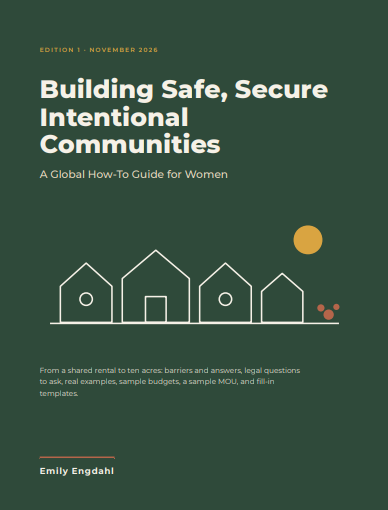 Image 1 of 1